


Digital Wayfinding: Smart Navigation Solutions for Modern Spaces
Navigating complex indoor environments is a universal challenge. When visitors get lost, frustration mounts, appointments are missed, and their overall perception of your organization drops. Traditional static plaques and printed maps often add to the confusion—they are hard to update, easily overlooked, and offer zero interactivity.
Enter digital wayfinding. This isn’t just a digital version of a paper map; it is a dynamic communication tool that guides people efficiently from point A to point B, revolutionizing the visitor experience.
Here is a deep dive into what electronic wayfinding systems are and why complex facilities are rapidly adopting them.
What is Digital Wayfinding?
At its core, digital wayfinding uses digital displays, such as touchscreen kiosks, wall-mounted screens, or mobile integrations, to help people orient themselves in a physical space and find their desired destination.
Unlike a static “You Are Here” map, a modern digital wayfinding solution is interactive and intelligent. It can provide:
- Turn-by-turn directions: A charted path from the user’s current location to their destination.
- Multi-modal support: Directions for walking, wheelchair accessibility, or elevators.
- Directory integration: Searchable databases of doctors, professors, retail stores, or departments.
- Mobile handoff: The ability to scan a QR code on a kiosk and take the directions with you on your smartphone.
Digital wayfinding is a technology-driven system that helps people navigate physical spaces using:
- Interactive touchscreens
- Digital maps
- Mobile apps
- QR codes
- Augmented reality (AR)
- Dynamic digital signage
It replaces static signs with real-time, smart navigation tools that adapt to changes and provide personalized directions.
Why Static Signage No Longer Cuts It?
If you manage a dynamic facility, static signage is a constant headache.
In a hospital, doctors move offices. On a campus, room functions change. In a mall, retailers come and go. Every time a change happens, a physical sign becomes obsolete. Updating them is costly, time-consuming, and environmentally unfriendly.
Furthermore, static signs are passive. They require the user to do all the cognitive work of figuring out where they are relative to where they want to go.

Why Digital Wayfinding Matters?
The rise of smart cities, IoT devices, and digital transformation initiatives has pushed organizations to adopt modern navigation systems to improve customer experience and operational efficiency.
Today, users expect:
- Instant point-to-point directions
- Multilingual content
- Live updates and alerts
- Accessibility-friendly routes
- Mobile-first guidance
Digital wayfinding makes all of this possible.
The Key Benefits of Interactive Indoor Navigation
Investing in a digital wayfinding system goes beyond just “fancy screens.” It offers tangible ROI in operational efficiency and user satisfaction.
1. Real-Time Updates and Flexibility
The biggest advantage of digital is agility. Did a conference room change at the last minute? You can update the digital directory instantly across the entire campus from a central content management system (CMS). No printing, no mounting, no delay.
2. Reduced Burden on Staff
How much time do your receptionists, security guards, or nurses spend giving basic directions? In large facilities, this accounts for hundreds of staffing hours per year. An intuitive wayfinding kiosk acts as a 24/7 concierge, freeing your staff to focus on high-value tasks.
3. Enhanced Visitor Experience and Reduced Stress
Getting lost is stressful, especially in healthcare environments. Clear, interactive directions alleviate anxiety. A positive, seamless arrival experience sets the tone for the entire visit, whether it’s a patient needing care or a prospective student visiting a university.
4. Valuable Analytics
Static signs can’t tell you anything. Digital systems can. You can track what visitors search for most often, identify popular destinations, and spot bottlenecks in your facility flow. This data is invaluable for future space planning.
Top Benefits of Digital Wayfinding
1. Improved Visitor Experience
Digital maps reduce confusion and anxiety—especially in complex environments like hospitals, airports, and convention centers.
2. Real-Time Information
Unlike traditional signage, digital wayfinding can update instantly:
- Room changes
- Closed areas
- Event schedules
- Emergency alerts
3. Increased Accessibility
Features may include:
- Wheelchair-friendly routes
- Audio guidance
- Multilingual interfaces
- High-contrast visuals
This makes public spaces more inclusive.
4. Enhanced Brand Engagement
Digital wayfinding kiosks can display:
- Promotions
- Event announcements
- Corporate branding
- Interactive content
This transforms navigation tools into marketing channels.
5. Optimized Traffic Flow
Smart routing prevents bottlenecks during events, peak hours, or emergencies by directing people through alternate paths.
6. Reduced Operational Costs
No more reprinting maps or updating physical signs:
- Digital signage lowers long-term maintenance costs
- Cloud-based updates save time
- Staff spend less time assisting lost visitors
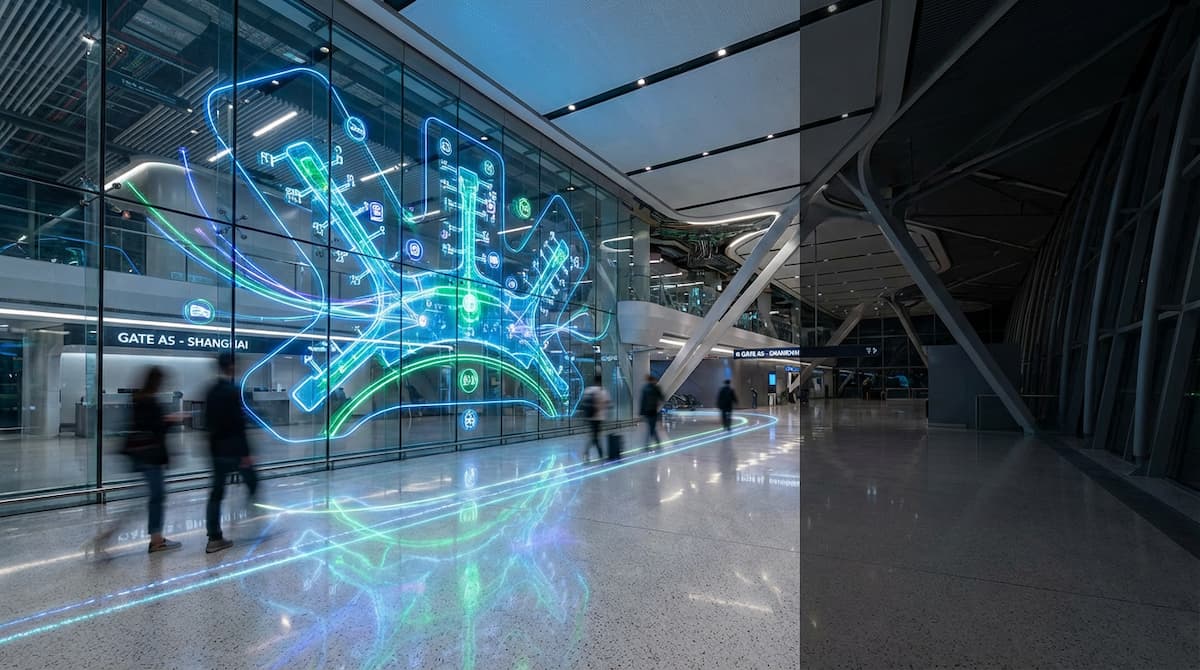
Key Features of an Effective Digital Wayfinding System
Interactive Maps
Zoomable, searchable, and easy to understand.
Mobile Integration
Provide QR codes or mobile apps for on-the-go navigation.
Indoor Positioning
Bluetooth beacons, Wi-Fi triangulation, or LiDAR for real-time indoor accuracy.
Multilingual Support
Essential for airports, malls, and tourist-heavy locations.
Emergency Mode
Override the system with instant evacuation routes.
Cloud-Based Management
Centralized updates — anytime, anywhere.
Where Digital Wayfinding Is Used?
1. Airports
Guiding passengers to boarding gates, lounges, baggage claim, and retail areas.
2. Corporate Campuses
Helping employees and visitors find meeting rooms, departments, and parking spaces.
3. Healthcare Facilities
Reducing stress by giving patients clear paths to clinics, labs, and departments.
4. Universities & Schools
Assisting students and visitors in navigating large academic buildings.
5. Retail Malls
Directing shoppers to stores, restrooms, and promotions.
6. Hotels & Resorts
Simplifying access to amenities like pools, restaurants, gyms, and conference halls.
7. Government Buildings
Enhancing security and public service accessibility.
The Future of Digital Wayfinding
Digital wayfinding is evolving fast with innovations like:
- AI-powered route optimization
- Voice-enabled navigation
- Augmented reality overlays
- 3D mapping and holographic displays
- Smart building automation integration
As smart cities rise, digital navigation systems will become a standard expectation in public and private spaces.
Is Your Facility Ready for a Digital Upgrade?
If your building has multiple floors, multiple wings, or a high volume of first-time visitors, relying solely on static signage is likely costing you in staff time and visitor satisfaction.
Digital wayfinding is no longer a futuristic luxury; it’s an expectation for modern, accessible, and user-friendly environments.
Frequently Asked Questions on Digital Wayfinding
1. What is digital wayfinding?
Digital wayfinding is a modern navigation system that uses digital maps, kiosks, mobile apps, and smart signage to guide people through indoor and outdoor spaces.
2. How does digital wayfinding work?
It works by combining digital maps, indoor positioning technologies, and interactive interfaces to provide real-time, step-by-step directions inside complex spaces.
3. Why is digital wayfinding important?
It improves visitor experience, reduces confusion, offers real-time updates, enhances accessibility, and increases operational efficiency in large public and private spaces.
4. Where is digital wayfinding commonly used?
Digital wayfinding is widely used in airports, hospitals, universities, malls, convention centers, hotels, and corporate campuses.
5. What are the benefits of digital wayfinding systems?
Key benefits include improved navigation, reduced staff workload, better traffic flow, stronger branding, and lower long-term signage costs.
6. Does digital wayfinding improve accessibility?
Yes. It supports wheelchair routes, audio guidance, high-contrast visuals, and multilingual content, making spaces more inclusive.
7. What technologies power digital wayfinding?
Technologies include GPS, Bluetooth beacons, Wi-Fi triangulation, QR codes, AI routing, and cloud-based content management systems.
Leave A Comment