

Dubai Loop: Everything You Need to Know About the New RTA Underground Transport System
Dubai is no stranger to futuristic infrastructure, but its latest announcement might be the most “sci-fi” yet. The Roads and Transport Authority (RTA) has officially commenced implementation of the Dubai Loop, a revolutionary underground transport network designed to serve as a city-wide “wormhole” for passengers.
Unlike the Dubai Metro or traditional trams, the Dubai Loop utilizes advanced tunneling technology to move electric vehicles underground at high speeds, bypassing surface traffic entirely.
Here is a deep dive into Phase 1, the technology behind the tunnels, and what this means for the future of mobility in the UAE.
Phase 1: The Pilot Route (DIFC to Dubai Mall)
The implementation of the first phase of the Dubai Loop project is set to begin with a 6.4km pilot route. This initial section is designed to prove the efficiency of the system in one of the city’s busiest corridors.
Key Phase 1 Stats:
- Route Length: 6.4 kilometers
- Stations: 4 dedicated underground stations
- Key Connections: Links the Dubai International Financial Centre (DIFC) directly to the Dubai Mall.
For residents and professionals working in the Financial District, this means a seamless, traffic-free commute to the world’s largest retail destination in a matter of minutes.
Dubai Loop: In a Glance
| Query | Output |
|---|---|
| Dubai Loop Project | A Dubai underground high-speed transport network, to be built by Elon Musk’s Boring Company |
| Dubai Loop RTA | The Dubai Loop project involves the construction of tunnels under the supervision of RTA. |
| Dubai Loop Stations | Dubai International Financial Centre, ICD Brookfield Place, Zaabeel Dubai Mall Parking, and Burj Khalifa/Dubai Mall |
| Dubai Loop Tunnel | The full Dubai Loop tunnel network will span 24 kilometres. |
| Dubai Loop Elon Musk | It was at WGS 2025 that RTA signed an MoU with Elon Musk’s TBC to bring the technology to Dubai. |
| Dubai Loop Plan | The Dubai Loop project covers 24 kilometers (14.9 miles) in Dubai, with a cost of nearly 2.5 billion ($680.81 million). |
| Dubai Loop Boring Company | Dubai will become the second city in the world to implement the tunnel-based transport system pioneered by the Boring Company. |
| Dubai Loop Location | The service will begin in the areas of the Dubai International Financial Centre (DIFC) and the Dubai Mall |
Dubai Loop Map
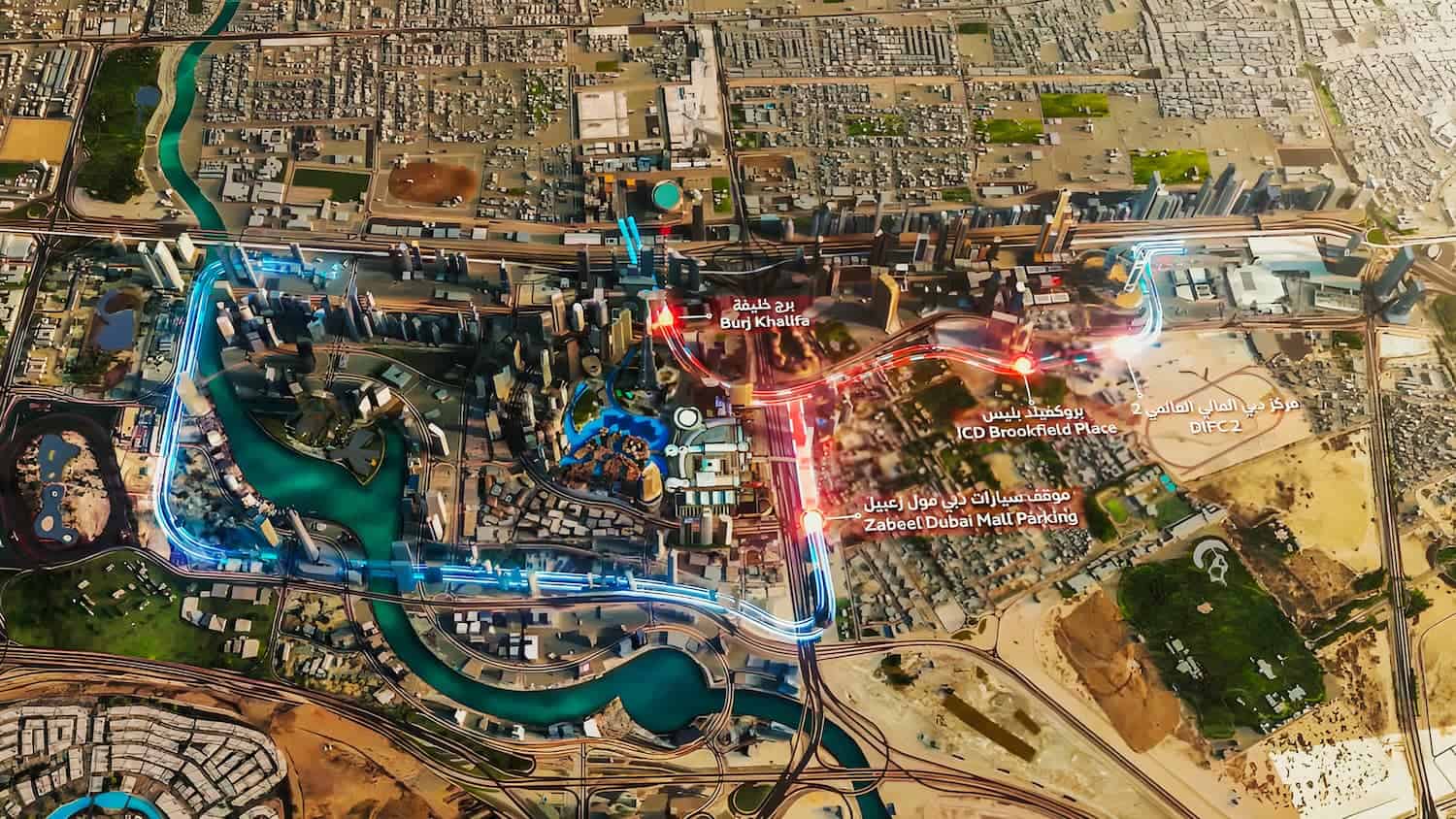
The Full Master Plan: 19 Stations and 22.2km
While the pilot route focuses on the DIFC-Downtown corridor, the full vision for the Dubai Loop is much broader. Phase 1 will pave the way for expansion into a comprehensive 22.2km alignment.
Once fully completed, the network will feature 19 stations connecting Dubai’s most vital economic hubs, including:
- Dubai World Trade Centre (DWTC)
- The Financial District (DIFC)
- Business Bay
This expansion aims to act as a relief valve for Sheikh Zayed Road, moving thousands of daily commuters underground and freeing up surface roads for essential traffic.
The Technology: 3.6m Tunnels & Boring Company
The engineering behind the Dubai Loop is what sets it apart from conventional subways. The project involves the construction of tunnels with a precise diameter of 3.6 meters, significantly smaller than a metro tunnel by Elon Musk’s The Boring Company.
Why does the size matter?
- Dedicated to Vehicle Transport: These tunnels are optimized for electric vehicles (Tesla-style sedans) rather than massive trains.
- Faster Delivery: The smaller diameter allows for the use of advanced tunneling technologies that can dig faster than traditional machines.
- Lower Construction Costs: Less excavation means significantly reduced material and labor costs.
- Minimal Disruption: The compact nature of the tunnels ensures reduced impact on existing roads, building foundations, and utilities compared to conventional heavy rail transport systems.
Dubai Loop vs. The “URB” Loop (Cycling)
Note for Readers: It is important to distinguish this project from “THE LOOP” proposed by developer URB. While URB’s concept focuses on a climate-controlled cycling and walking highway, the RTA Dubai Loop discussed here is a vehicular underground transport system focused on high-speed commuting.
Why This Matters for Dubai Real Estate & Business
The RTA Dubai Loop represents a massive value-add for properties in DIFC, Downtown, and Business Bay. The promise of “door-to-door” underground transport increases the appeal of these districts for multinational corporations and high-net-worth residents who value time above all else.
As Dubai prepares for a population boom under the 2040 Urban Master Plan, the Dubai Loop is a critical step toward a zero-emission, congestion-free future.
Frequently Asked Questions on Dubai Loop
What exactly is the RTA Dubai Loop?
The Dubai Loop is a new underground urban transport system commissioned by the Roads and Transport Authority (RTA). Unlike a traditional subway, it utilizes a network of tunnels (3.6 meters in diameter) dedicated to autonomous electric vehicles that transport passengers directly to their destination without intermediate stops.
Which areas will Phase 1 of the Dubai Loop connect?
The initial “Pilot Phase” spans 6.4 kilometers and connects the Dubai International Financial Centre (DIFC) with Dubai Mall. It features four underground stations designed to ease traffic in this high-congestion corridor.
When is the Dubai Loop expected to open?
While an exact opening date hasn’t been set, the RTA has announced that the implementation of Phase 1 will commence immediately. The construction of the pilot route is estimated to take approximately one year following the completion of final designs.
Is the Dubai Loop a train or a car system?
It is neither a train nor a standard road. It is a “point-to-point” system using electric vehicles (likely pods or sedans similar to Tesla vehicles) that travel inside dedicated tunnels. This allows for continuous movement without the delays of traffic lights or station stops.
How fast will the vehicles travel in the Dubai Loop?
The system is designed for high-speed urban travel. While specific operational speeds for Dubai are yet to be finalized, the technology (based on The Boring Company’s Loop in Las Vegas) is capable of speeds up to 150 km/h (93 mph), though urban loops typically operate between 60–100 km/h to ensure passenger comfort.
Who is building the Dubai Loop?
The project is a partnership between Dubai’s Roads and Transport Authority (RTA) and The Boring Company, an American infrastructure services company founded by Elon Musk, known for its fast-to-dig tunneling technology.
How is this different from the “URB Loop” (The Green Spine)?
This is a common confusion. The RTA Dubai Loop is an underground vehicular transport system. The URB Loop (often just called “THE LOOP”) is a separate conceptual proposal for a 93km climate-controlled cycling and walking highway. They are two completely different projects.
How much will the project cost to build?
Phase 1 (the pilot route) is estimated to cost approximately AED 565 million. The full 22.2km network, once completed, is projected to cost around AED 2 billion.
What are the benefits of the smaller 3.6m tunnels?
Standard metro tunnels are much larger and more expensive to dig. The Dubai Loop’s 3.6-meter-diameter tunnels are faster to construct, cost significantly less, and cause minimal disruption to existing building foundations and utilities in dense areas like Downtown Dubai.
What is the capacity of the Dubai Loop?
The pilot route (Phase 1) is expected to accommodate roughly 13,000 passengers per day. Once the full 19-station network is operational, capacity is projected to rise to 30,000+ passengers per day, serving as a vital relief valve for surface traffic.
Leave A Comment